Executive Overview & Architectural Significance
The continuous scaling of modern enterprise engineering organizations introduces substantial operational overhead, particularly regarding repository lifecycle governance and outside collaborator permissions. As codebases multiply across shared ecosystems, repository owners frequently struggle to track active collaborators, manage evolving access policies, and gracefully sunset dead or dormant assets. Manual administrative housekeeping inevitably falls by the wayside, creating invisible security vectors and compliance gaps. To solve these friction points at scale, GitHub introduced Evergreen, a native GitHub App engineered to automate organizational hygiene without relying on complex, external SaaS platforms.
Architecturally, Evergreen embodies a minimalist paradigm: "One brain, many hands." Rather than inventing exotic middleware or maintaining disparate databases, Evergreen leverages first-class, stock GitHub primitives—including GitHub Apps, scheduled actions, webhooks, issues, custom properties, and plain files stored directly inside a dedicated controller repository. By anchoring state management directly into Git commits, the platform transforms the commit history itself into an unalterable, transparent audit trail. This design marries rigorous security mandates with native developer ergonomics, ensuring that operational governance feels like standard code review rather than bureaucratic friction.
Core Enhancements & Developer Ergonomics
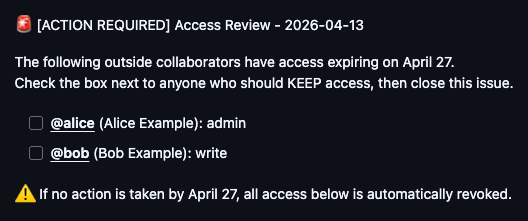
Evergreen operates through two primary automated workflows: quarterly outside-collaborator access reviews and stale repository detection. Under the collaborator access review cycle, a snapshot of external users is captured, and a checklist issue is dynamically generated for each repository two weeks prior to enforcement. Developers interact with this mechanism via Issue-Ops: checking the boxes for collaborators who retain validity and closing the issue triggers an immediate webhook event (issues.closed) that updates permissions accordingly. To enforce strict access control, Evergreen validates the actor closing the issue; if an unauthorized user attempts to close the review, the app automatically reopens the thread and posts a corrective notice.
The second major workflow addresses repository sprawl through intelligent staleness detection and graceful archival. Repositories exhibiting zero human activity past a defined threshold are systematically flagged, warned via tracking issues, and ultimately archived if left untouched following a hard grace period. Crucially, Evergreen adheres to a strict "Fail Secure" and "Never Destroy" philosophy. If a quarterly access review is entirely ignored by repository stakeholders, default policies dictate that external access is systematically revoked rather than left indefinitely exposed. Simultaneously, the application guarantees that codebases are never permanently deleted; archived repositories remain fully recoverable, and every state mutation is explicitly logged to facilitate instant rollbacks or queries via GitHub Copilot.
Architectural Comparison Matrix
| Operational Metric | Previous Baseline (Manual / Bespoke Scripts) | vLatest Evergreen Architecture | Architectural Impact |
|---|---|---|---|
| Audit Trail Latency | High (Asynchronous log shipping to external SIEM/DB) | Instant (Synchronous Git commit history via git log) |
Eliminates external database synchronization lag and infrastructure cost. |
| Memory Footprint | Variable (Heavy Python/Node worker clusters) | Minimal (Lightweight Go webhook server in container) | Significantly reduces container resource allocation and scaling complexity. |
| API Surface & Dependencies | Custom REST integrations, third-party auth tokens | Stock GitHub App, Webhooks, Actions, Native Issues | Maximizes system resilience by relying strictly on core platform primitives. |
Breaking Changes & Migration Caveats
Transitioning to the Evergreen governance model introduces distinct operational prerequisites rather than traditional software breaking changes. Because state is managed via discrete JSON files located at state/repos/<repo_id>.json within the controller repository, organizations must ensure proper branch protection rules and CODEOWNERS configurations are enforced on the controller repository itself. Furthermore, teams must define ownership resolution logic—either via the evergreen_repo_owner custom property or through fallback heuristics analyzing recent commit and issue authors—to prevent unassigned review tasks from falling into operational voids.
Step-by-Step Upgrade Guide
Implementing Evergreen within your organization requires setting up the controller repository and deploying the Go webhook server. Follow these core configuration steps:
Deploy the Controller Repository and Go Webhook Server: Provision a private controller repository to act as Evergreen's central clock and memory. Deploy the Go webhook server container and configure your GitHub App with permissions for repository administration, issues, and workflows.
Configure Scheduled GitHub Actions Workflows: Commit the quarterly scheduling workflows to the controller repository. Ensure the scheduled events dispatch
repository_dispatchtriggers according to your desired cadence:on: schedule: - cron: '0 0 1,8,16,23 * *' jobs: dispatch: runs-on: ubuntu-latest steps: - name: Trigger Evergreen Controller uses: actions/github-script@v6 with: script: | await github.rest.repos.createDispatchEvent({ owner: context.repo.owner, repo: context.repo.repo, event_type: 'evergreen_tick' });Initialize Repository State and Custom Properties: Define the
evergreen_repo_ownercustom property at the organization level or establish standard fallback rules for commit/issue authorship to guarantee proper escalation paths during quarterly access reviews.