1. Executive Overview & Architectural Significance
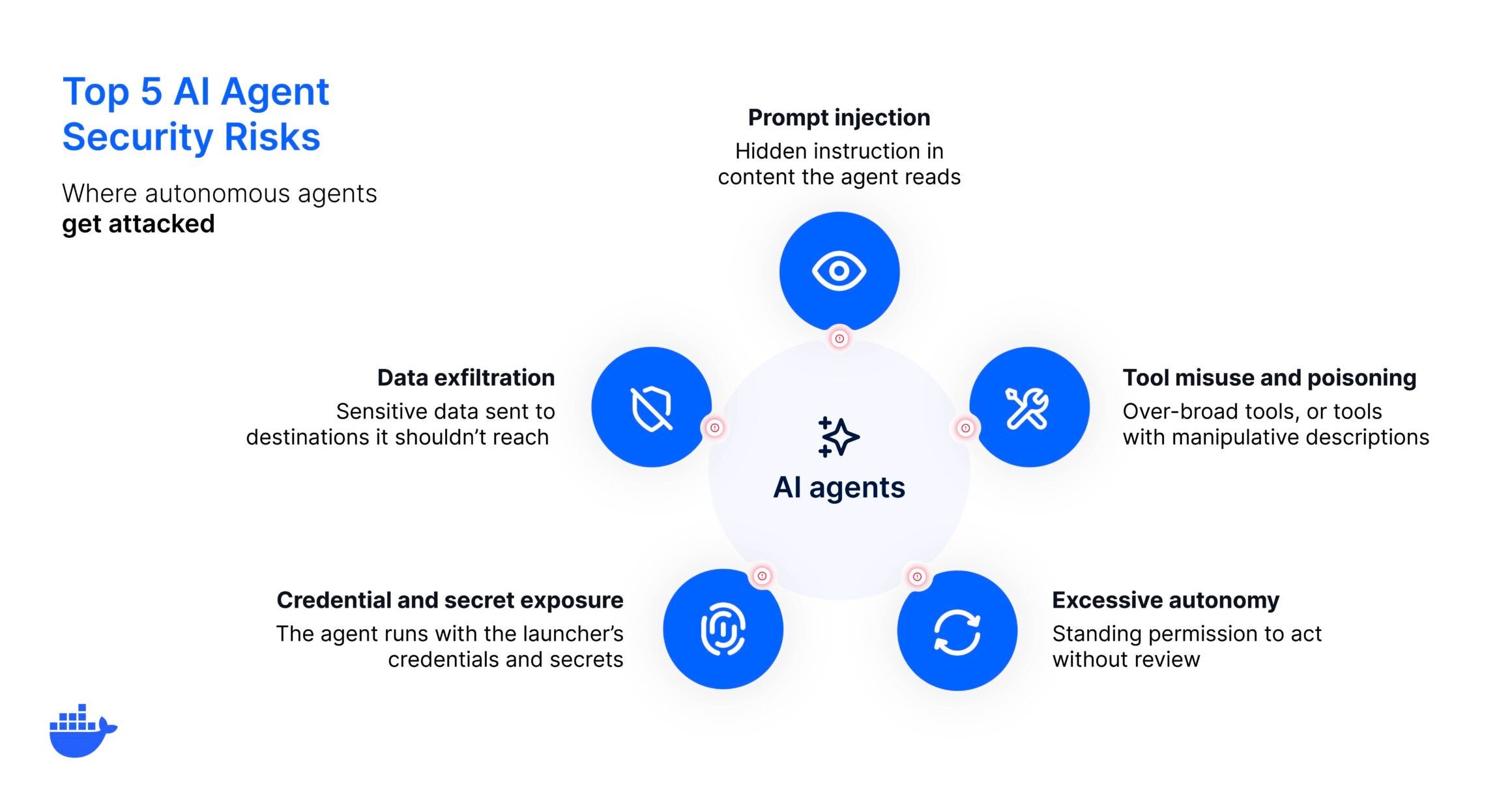
The integration of autonomous artificial intelligence agents into software development workflows represents a paradigm shift that fundamentally breaks traditional application security models. Historically, application security relied on predictable, deterministic endpoints processing well-defined requests under strict perimeter defenses. Modern AI agents, however, dynamically interpret instructions, autonomously select runtime tools, and execute multi-step logic chains with minimal human intervention. While this autonomy delivers unprecedented developer velocity, it introduces a severe expansion of the threat surface. When a system allows an unconstrained agent to browse codebases, execute arbitrary terminal commands, and leverage developer-level credentials, any single instance of prompt injection or tool poisoning can result in catastrophic system-wide failures.
Docker’s latest release advisory addresses these systemic vulnerabilities by emphasizing that trust cannot be assumed or handled at the model layer alone; it must be engineered into the surrounding infrastructure. The architectural challenge lies in balancing agent freedom with absolute system containment. By treating every incoming data stream—whether a code comment, a fetched web page, or an inter-agent handoff—as untrusted input, platform engineers can mitigate the blast radius of compromised workloads. This release analysis explores the core attack vectors, evaluates the structural requirements for isolation and governance, and provides actionable pathways for securing agentic workflows within containerized environments.
2. Core Enhancements & Developer Ergonomics
To counter the inherent risks of excessive autonomy, such as accidental data destruction via unchecked commands or unintended production environment deletions, this release highlights critical hardening patterns for agentic execution. Developers frequently rely on permissive setups, colloquially known as "YOLO mode," where all agentic actions execute instantly without manual confirmation gates. While disabling this autonomy entirely defeats the purpose of employing intelligent agents, running them directly on host operating systems exposes underlying filesystems, SSH keys, and personal tokens to immediate compromise.
From a developer ergonomics standpoint, the recommended approach decouples the agent from the host machine by enforcing ephemeral, containerized execution environments. By provisioning agents with strictly scoped, short-lived credentials that are dynamically injected at runtime—rather than inheriting personal developer tokens—organizations prevent lateral movement in the event of an exploit. Furthermore, establishing explicit network egress filters and leveraging registries with verified provenance for Model Context Protocol (MCP) tools ensures that tool poisoning and data exfiltration vectors are systematically neutralized before execution begins.
3. Architectural Comparison Matrix
| Architectural Dimension | Previous Baseline (Uncontained AI Execution) | Updated Paradigm (ai-agent-security-risks-what-can) |
Architectural Impact |
|---|---|---|---|
| Execution Latency | Near-instant execution with direct host access; prone to unbounded process loops. | Controlled initialization overhead with negligible runtime latency overhead via containerization. | Trades fractional startup latency for absolute host isolation and blast-radius containment. |
| Memory & State Isolation | Shared host memory spaces and persistent local file system states susceptible to recursive deletion (rm -rf). |
Ephemeral container memory spaces with strictly bounded volume mounts and isolated tmpfs layers. | Prevents rogue code execution chains from modifying host system files or credential stores. |
| API & Tool Governance | Broad, standing API permissions inheriting developer tokens; unvalidated tool selection. | Scoped, short-lived runtime credentials with explicit egress filtering and verified tool registries. | Minimizes credential exposure and eliminates untrusted tool poisoning vectors. |
4. Breaking Changes & Migration Caveats
Transitioning to secure agentic architectures introduces deliberate operational friction designed to protect infrastructure assets. Most notably, agents can no longer implicitly inherit host-level environment variables, personal SSH keys, or administrative cloud tokens. This architectural change will break legacy local development scripts that assume autonomous coding assistants possess unhindered access to local configuration files and production cloud APIs.
Organizations must explicitly migrate away from running unverified MCP tools and auto-approved execution modes. Developers accustomed to zero-friction prompts must adapt to policy-driven runtime validations, where file system write scopes and network egress endpoints are programmatically enforced. Failure to provision explicit, short-lived credentials will result in authentication errors during multi-step agent execution chains.
5. Step-by-Step Upgrade Guide
To successfully secure your agentic workflows and implement robust runtime containment, follow this 3-step migration process:
Isolate the Agent Runtime Environment Deploy your coding agents inside disposable, ephemeral containers rather than executing them directly on the host machine. Ensure that sensitive host directories are unmounted or mounted strictly as read-only.
# docker-compose.agent.yml
version: '3.8'
services:
  ai-agent:
    image: secure-agent-runtime:latest
    read_only: true
    volumes:
      - ./workspace:/workspace:rw
      - /tmp:/tmp:rw
    environment:
      - AGENT_YOLO_MODE=false
    network_mode: "bridge"
Enforce Scoped, Short-Lived Credentials Strip personal operator tokens from your agent sessions. Inject limited-scope tokens dynamically at runtime, ensuring permissions expire immediately upon task completion.
# Example command to run an agent with injected, temporary credentials
docker run --rm -it \
  --mount type=bind,source=$(pwd)/workspace,target=/workspace \
  -e AWS_ACCESS_KEY_ID=$TEMP_AGENT_KEY \
  -e AWS_SECRET_ACCESS_KEY=$TEMP_AGENT_SECRET \
  secure-agent-runtime:latest --task "refactor utils.py"
Implement Network Egress and Tool Verification Lock down container networking rules to restrict outbound traffic exclusively to approved internal registries and known API endpoints, while sourcing all tools from verified provenance registries.