Executive Overview & Architectural Significance
The Rust compiler team has reached a major milestone by enabling the parallel frontend by default in the nightly release channel. Historically, the Rust compiler utilized multi-threading solely within the LLVM-based backend, while the frontend—responsible for type checking and borrow checking—operated as a single-threaded process. This bottleneck has long been the primary constraint on compilation speed for large codebases. By transitioning the frontend to a multi-threaded architecture, the compiler can now distribute these computationally expensive analysis tasks across multiple CPU cores, effectively reducing latency in the most critical paths of the compilation pipeline.
This architectural shift is the culmination of a multi-year effort to refine thread safety and memory management within rustc. While previous attempts at parallelization were hindered by stability concerns, intensive work by the compiler team has addressed long-standing issues, making the current implementation robust enough for broad nightly evaluation. This change represents a significant leap toward achieving near-linear scaling for common developer workflows, positioning Rust to maintain its performance edge as project complexity continues to grow.
Core Enhancements & Developer Ergonomics
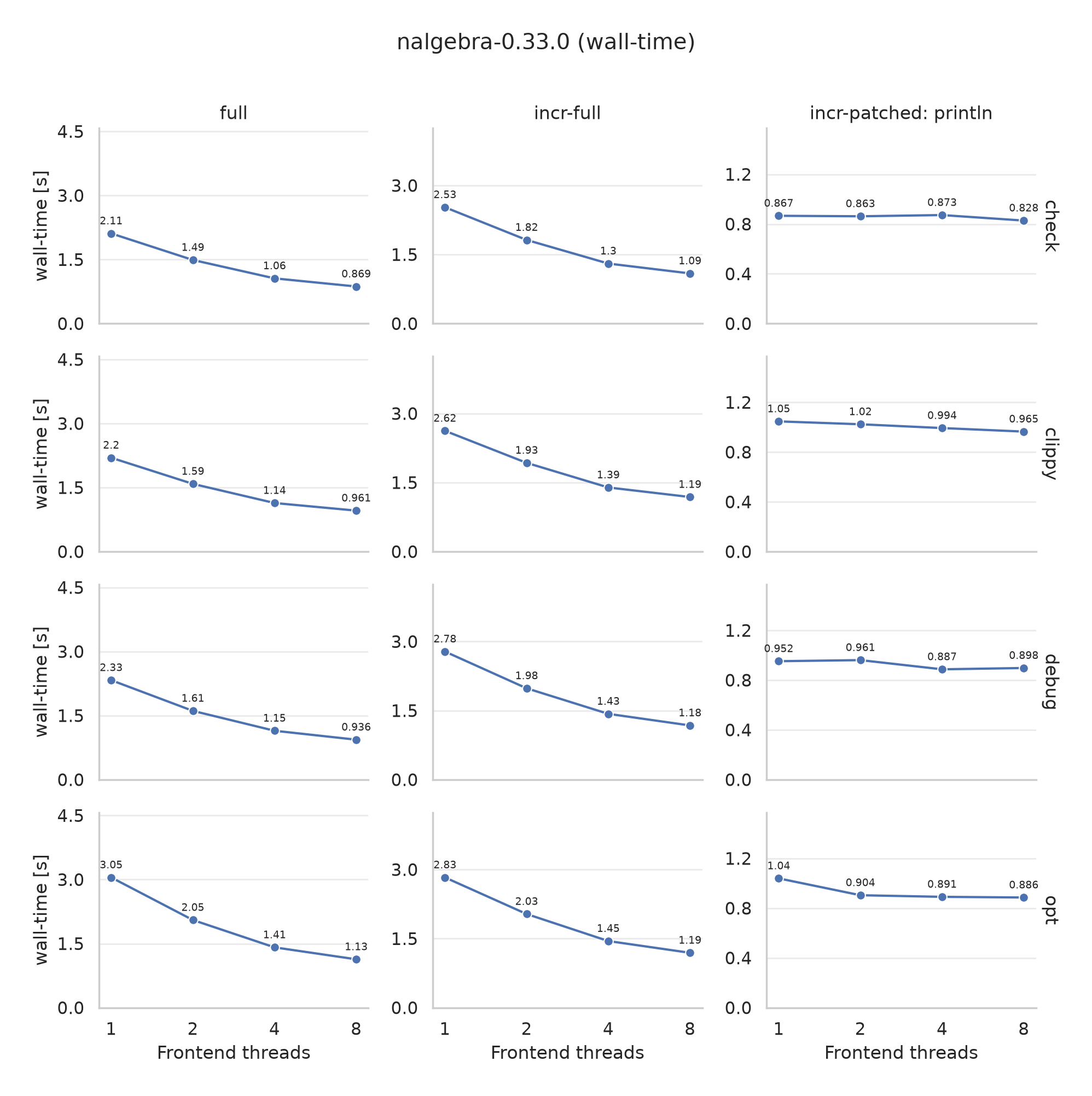
The performance gains provided by the parallel frontend are most evident during cargo check and clippy operations, where benchmarks show substantial improvements. Testing indicates that utilizing 8 threads can deliver a nearly 2x speed increase for specific crate-level compilations. Although incremental rebuild performance improvements are more modest (approximately 3–5%), the overall reduction in cold-start compilation times significantly enhances the iterative developer feedback loop.
To manage resource allocation, the compiler defaults to a conservative 2-thread policy. However, developers can tune this via the --jobs-frontend flag. While performance currently plateaus around 8 threads for most workloads, this configuration allows power users to tailor the compiler's behavior to their specific hardware environments. Note that increased thread counts correlate with higher memory consumption; users should monitor their system memory utilization to avoid OOM events during intensive build tasks.
Migration Notes & Upgrade Practicalities
This feature is currently restricted to the nightly channel. It remains fully backwards-compatible for users on the stable release, which continues to use the sequential frontend by default. If you are using the nightly toolchain and encounter non-deterministic diagnostic output or reproducibility issues, you may revert to the sequential behavior by configuring the RUSTFLAGS environment variable to include --jobs-frontend=1. The team is actively soliciting feedback on any regressions or crashes found via the designated GitHub tracking issues to ensure a smooth path toward future stable integration.