Executive Overview & Architectural Significance
The introduction of the next-generation trait solver represents the most profound architectural transformation of the Rust compiler since its inception. After four years of rigorous development, this transition marks a shift away from the legacy proof system toward a more robust, consistent, and maintainable engine. By fundamentally re-engineering how the compiler processes where-clauses and normalizes associated types, the project team is effectively removing long-standing technical debt that has historically constrained the language's evolution. This change is not merely an optimization; it is a foundational prerequisite for high-impact future features, including Type Alias Impl Trait (TAIT) and Return Type Notation (RTN).
Architecturally, this migration unblocks the path to resolving deep-seated type system unsoundnesses that were essentially untouchable under the old solver. By moving to the new architecture, the compiler gains the ability to handle complex trait bound requirements more predictably. While the immediate benefits are primarily internal, they set the stage for systemic improvements in language expressivity. The shift is designed to ensure that the Rust compiler remains a scalable, high-performance tool capable of meeting the demands of modern systems programming as the complexity of the ecosystem continues to grow.
Core Enhancements & Developer Ergonomics
One of the most immediate impacts of the new solver is the significantly improved handling of opaque types. The legacy implementation often relied on brittle special-casing for return-position impl Trait (RPIT), which created fragmented behavior across different code structures. With the new solver, RPIT and related constructs behave with greater uniformity. Developers will notice that recursive function calls—previously problematic in specific type-checking scenarios—are now handled correctly, allowing for more intuitive code composition without encountering the cryptic errors that plagued the old implementation.
Furthermore, the solver introduces superior handling of associated types within higher-ranked types. By fixing how the compiler interacts with lifetimes in for<'a> binders, the new solver resolves a wide array of previous false-negative errors in complex generic code. This effectively makes the compiler smarter about proof-testing where-bounds, particularly when dealing with trait bounds that depend on associated types. As a result, code that once required workarounds or explicit trait annotations now compiles cleanly, lowering the barrier to writing highly generic, library-focused Rust code.
Architectural Comparison Matrix
| Feature | Legacy Solver | Next-Gen Solver (vLatest) |
|---|---|---|
| Trait Proof Logic | Heuristic-based, legacy patterns | Unified, constraint-driven engine |
| Associated Type Support | Limited in higher-ranked contexts | First-class, robust binder handling |
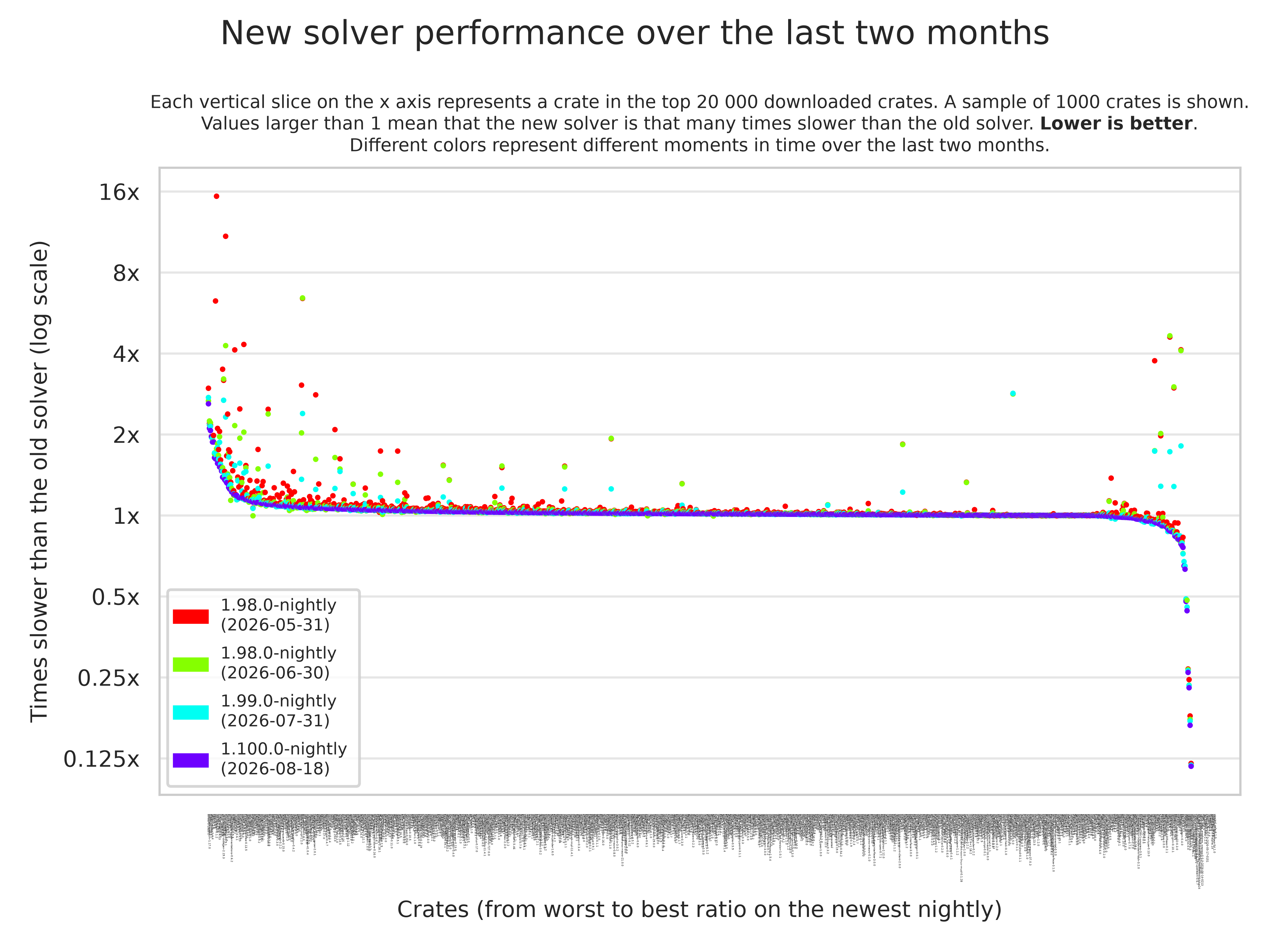
| Compile-time Latency | Optimized, mature | Variable, undergoing iterative tuning |
| Memory Footprint | Stable but restrictive | Higher peaks, better structural limits |
| Future-proofing | Blocked for TAIT/RTN | Fully enabled for TAIT/RTN |
Breaking Changes & Migration Caveats
Transitioning to the new solver is a major shift that entails non-trivial breaking changes. The update is primarily focused on enforcing correct type inference, which means code relying on "accidental" behavior or subtle bugs in the previous solver will likely fail to compile. This is a intentional byproduct of tightening the compiler's safety guarantees. Developers should treat this as a strict enforcement of correct Rust semantics. A comprehensive registry of known breakages is maintained in the official tracking issue, and users are encouraged to audit their test suites against these documented regressions.
Step-by-Step Upgrade Guide
Prepare the Nightly Environment: Ensure your toolchain is up to date by running
rustup update nightlyin your terminal.Configure Your Project: Opt-in to the new solver behavior globally or per-project. Add the following to your
.cargo/config.toml:[build] rustflags = ["-Znext-solver=coherence"]Test and Validate: Run
cargo checkandcargo testacross your codebase. If you encounter unexpected compilation errors, compare them against the official tracking issue before reporting new bugs.