Executive Overview & Architectural Significance
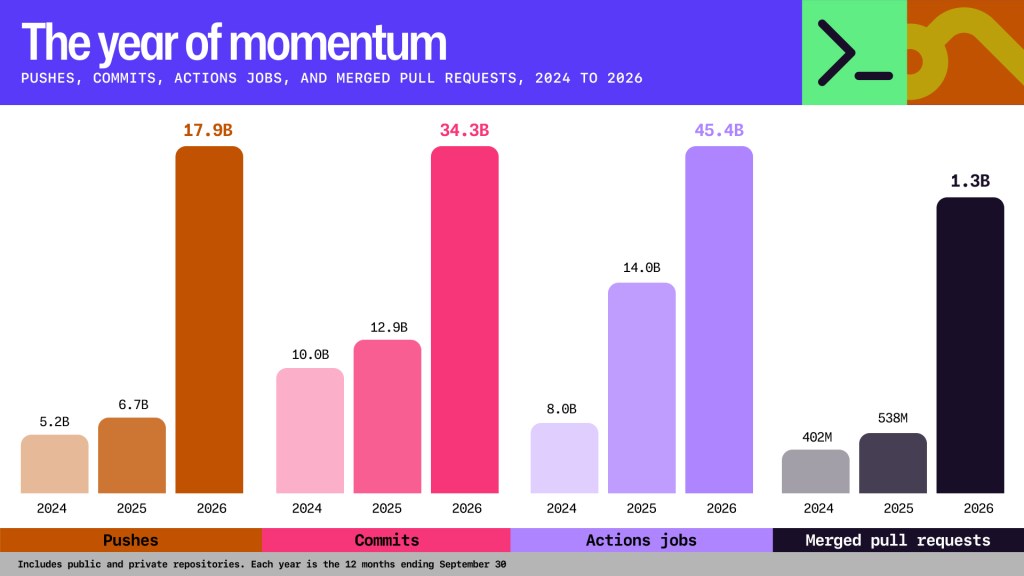
The software development landscape has experienced an unprecedented paradigm shift, underscored by the release data in GitHub's latest metric cycle, octoverse-commits-pushes-reach-n. Over the past twelve months, the platform recorded a staggering 17.9 billion code pushes—surpassing the combined totals of the preceding two years. This hyper-accelerated velocity is not merely a reflection of a growing developer base; it marks a structural inflection point driven by the widespread maturation of AI coding agents, diverse model orchestration, and highly scalable cloud-native CI/CD frameworks. The velocity of modern engineering organizations has decoupled from linear human bandwidth, thanks to persistent, multi-day agentic workflows that coordinate autonomously across distributed repositories.
Architecturally, this release cycle highlights a profound evolution in how software is conceptualized, built, and maintained. Telemetry data reveals that codebases initialized with native AI agent configuration files exhibit an astonishing eightfold increase in commit frequency compared to traditional repositories. Furthermore, over 40% of all pull requests now initiate from an agent-driven instruction set rather than manual boilerplate creation. This shift forces a complete reimagining of the software development lifecycle (SDLC), transforming the developer from a manual syntax writer into a high-level architectural director who focuses primarily on automated code review, constraint validation, and systems integration. The implications extend far beyond traditional web and enterprise software, catalyzing modern implementations in non-traditional domains such as health care, agriculture, and embedded space hardware.
Core Enhancements & Developer Ergonomics
The core engineering enhancements powering octoverse-commits-pushes-reach-n center on advanced model interoperability and automated infrastructure scaling. Developers are no longer tethered to a single monolithic large language model (LLM); instead, telemetry indicates that 61% of GitHub Copilot users leverage multiple distinct models within a single month. Workloads are dynamically routed across general-purpose engines, deep reasoning and planning modules, and fast, lightweight optimization networks. This heterogeneous model selection empowers engineering teams to match specific computational sub-tasks—such as complex refactoring versus trivial documentation generation—with the most cost-effective and structurally accurate underlying model.
Developer ergonomics have simultaneously transformed through massively scaled automation pipelines. GitHub Actions handled an astronomical 45.4 billion jobs over the past year, translating to a consistent baseline load of 1,440 concurrent job executions every second. This scaling is complemented by automated security maintenance via Dependabot, which saw developers merge over 30 million pull requests to patch vulnerabilities at twice the historical velocity. Additionally, the evolution of agents from transient, single-session command line utilities into persistent cloud-orchestrated entities allows for continuous integration checking, background test execution, and multi-file code refactoring without demanding local CPU resources or direct developer supervision.
Architectural Comparison Matrix
| Performance & System Vector | Previous Baseline (Legacy Octoverse) | Current Release (octoverse-commits-pushes-reach-n) |
Architectural Impact |
|---|---|---|---|
| Task Latency / Execution Time | Synchronous, local execution; high manual overhead | Asynchronous, cloud-harnessed remote agent execution | Reduced time-to-PR and accelerated multi-file refactoring cycles. |
| Resource Memory Footprint | Local IDE memory constraints during heavy code indexing | Offloaded cloud compute for persistent multi-day agents | Eliminates local hardware bottlenecks during complex code generation. |
| Model & API Interoperability | Monolithic reliance on a single primary LLM backend | Multi-model routing (General, Reasoning, Lightweight) | Optimized cost-performance ratios tailored per engineering task. |
Breaking Changes & Migration Caveats
octoverse-commits-pushes-reach-n represents a systemic metric and platform capability update rather than a traditional breaking software library release; consequently, it is fully backwards-compatible with existing repository structures, workflows, and API integrations. However, engineering organizations transitioning to agent-first development paradigms must account for subtle systemic shifts. Teams attempting to adopt autonomous agent configuration files without establishing rigorous automated testing pipelines and semantic pull request review policies will likely encounter severe technical debt accumulation due to the sheer volume of generated code. Security boundaries must also be explicitly defined via GitHub Actions permission scopes to prevent runaway agentic loops from mismanaging cloud infrastructure or exposing sensitive environment variables.
Step-by-Step Upgrade Guide
To fully leverage the architectural velocities and multi-model agent capabilities highlighted in this release cycle, engineering teams should execute the following modernization steps:
- Define Agent Configurations: Introduce standardized agent configuration profiles within your repository root to enable contextual awareness for AI tools.
{ "version": "2.0", "agent": { "default_model": "deep-reasoning-v3", "fallback_model": "fast-lightweight-v1", "auto_pr_generation": true, "allowed_actions": ["test", "lint", "refactor"] } } - Scale CI/CD Action Concurrency: Update your GitHub Actions workflows to handle increased automated throughput, ensuring dependency pinning and automated vulnerability patching via Dependabot are active.
name: Automated-Agent-Pipeline on: pull_request: branches: [ main ] jobs: validate-agent-code: runs-on: ubuntu-latest steps: - uses: actions/checkout@v4 - name: Run Automated Test Suite run: npm test - Diversify Model Routing: Configure your Copilot and enterprise integration settings to allow dynamic model switching, optimizing workloads between fast code completion engines and deep reasoning architectures based on task complexity.