Executive Overview & Architectural Significance
GitHub has announced the Agent Host Protocol (AHP), an open standard designed to decouple AI agent sessions from single-application lifecycles. Historically, tools like GitHub Copilot relied on editor-bound extensions whose operational lifespan was strictly tied to a single application window. Updating an integrated development environment, rebooting a workspace, or switching contexts would immediately terminate active agent tasks. AHP solves this foundational limitation by providing an independent, standardized communication layer that maintains session state, history, and active execution across disparate environments such as VS Code, native mobile applications, and custom developer workflows.
Architecturally, AHP shifts the paradigm away from bespoke, one-off client integrations toward a decoupled host-client model. By separating agent interaction mechanics from core agent behaviors—much like the Language Server Protocol (LSP) and Debug Adapter Protocol (DAP)—AHP standardizes how clients communicate with execution engines. This eliminates tight coupling to specific workbench versions or remote extension hosts, granting developers persistent, asynchronous agent sessions that seamlessly resume across terminal interfaces, desktop environments, and cloud infrastructure.
Core Enhancements & Developer Ergonomics
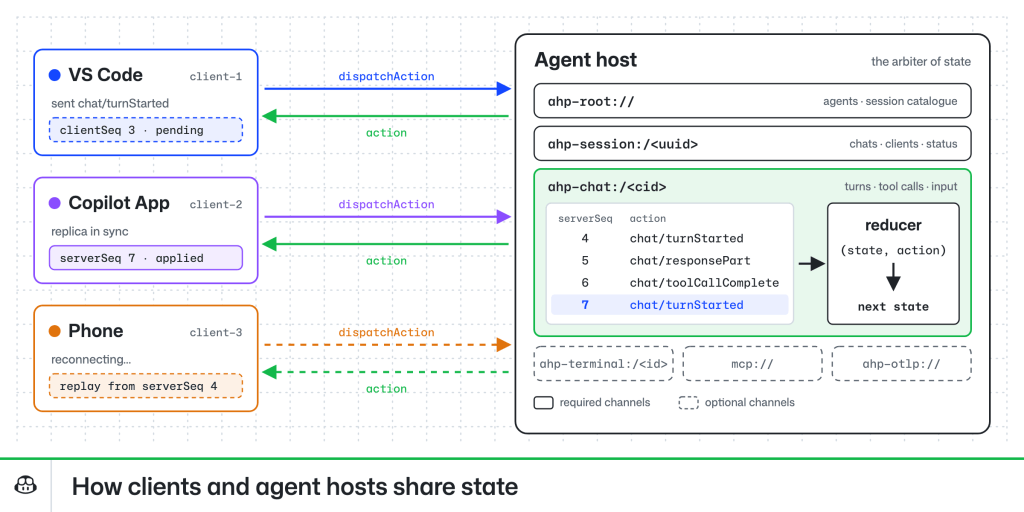
The Agent Host Protocol introduces URI-identified channels as the coarsest unit of protocol functionality. Every AHP-compliant server must implement root, session, and chat channels, while optionally supporting extended capabilities such as terminal integration, Model Context Protocol (MCP) additions, and OpenTelemetry (OTel) reporting. Within these channels, state management relies entirely on a reducer-based architecture. The server acts as the authoritative arbiter of state, processing sequences of client-dispatched actions that either mutate state or trigger asynchronous side effects like message delivery.
This reducer pattern yields significant developer ergonomics and system resilience. Network interruptions and reconnections are easily handled: clients queue actions, render localized loading states, and wait for server reconciliation. Furthermore, the deterministic nature of reducer-based state maps intuitively to modern reactive UI frameworks, streamlining debugging for both client and server implementations while ensuring uniform state representation across up to five concurrent client surfaces.
Migration Notes & Upgrade Practicalities
Adopting AHP required a massive structural overhaul within VS Code, replacing a legacy Copilot Chat extension exceeding 400,000 lines of TypeScript with a standalone agent host process built on the Copilot SDK. Developers migrating to multi-client AHP workflows should note that local extension integrations must transition to the new host harness. While the protocol itself is standardized, legacy window-bound extension architectures are incompatible with cloud-mediated session continuity and require upgrading client implementations to support AHP-compliant transport layers.